
Guide: how to choose a vibration isolator, spring or rubber?
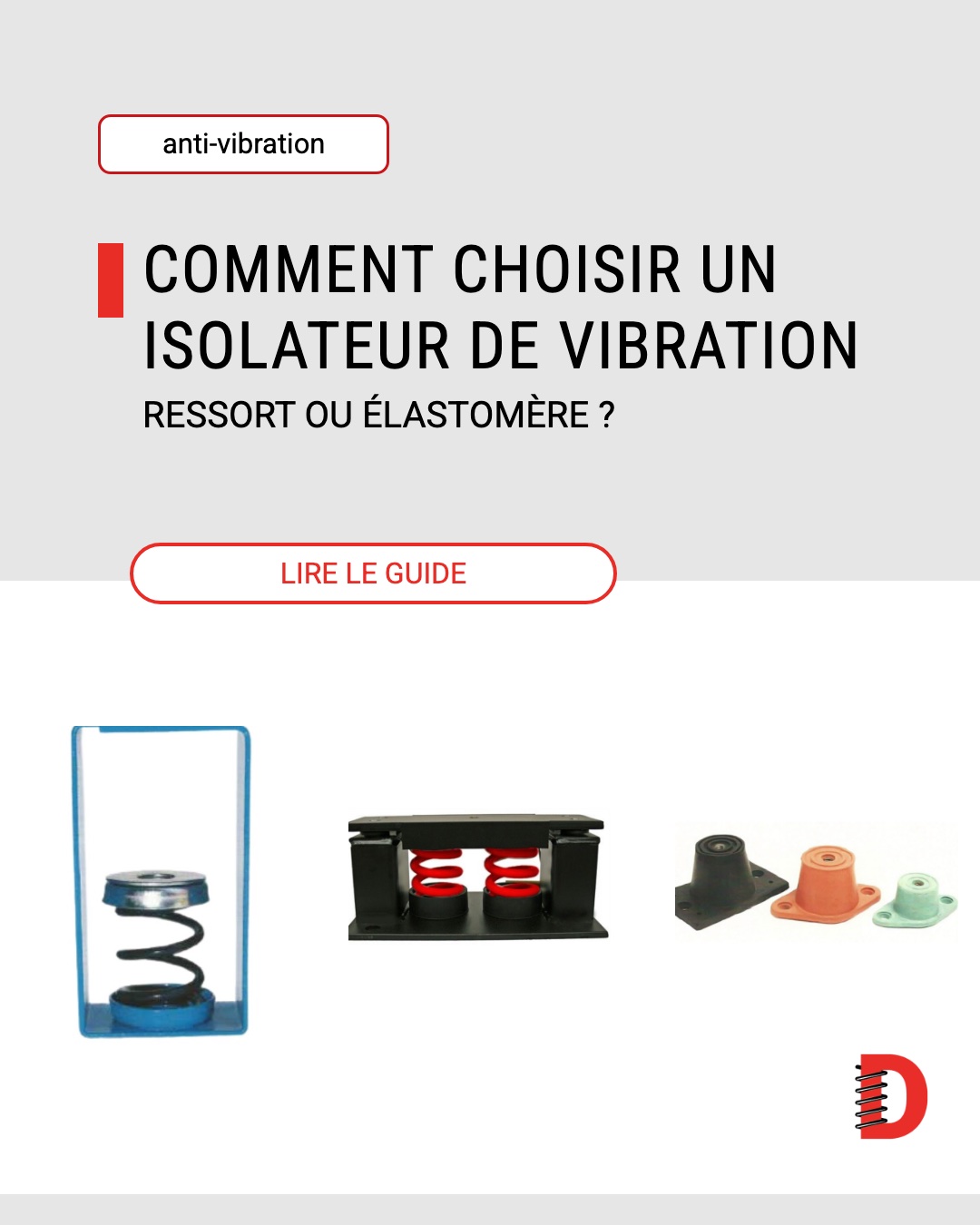
In short: a vibration isolator is chosen from three figures: the load carried by each support, the static deflection required by the specification, and how it is mounted (on the floor or suspended). Spring isolators offer the greatest deflection; rubber isolators suit cases where a smaller deflection is enough.
1. Work out the load per support
Start from the operating weight of the equipment, with its fluid and accessories, and spread it over the number of supports or hangers. Weight is rarely evenly distributed: ask the equipment manufacturer for the load at each support point. Each isolator must be chosen within the load range of its model.
2. Find the required deflection
Static deflection is how much the isolator compresses under the weight of the equipment. The greater it is, the better the isolator filters low-frequency vibration, the kind produced by slow-turning equipment. On a construction project, the engineer sets the minimum deflection in the specification, according to the equipment and the structure carrying it.
3. Spring or rubber?
| Type | Deflection | Deflection series |
|---|---|---|
| Spring hanger | 0.5 to 2.25 in | SH, SHE1, SHL1, SHL2, SHM (20 to 1,300 lb) |
| Seismic spring floor isolator | up to 2 in | SM1, SM2, VSR1, VSR2 (25 to 5,600 lb) |
| Neoprene hanger | 0.4 to 0.5 in | EHD (33 to 370 lb) |
| Rubber floor mount | 0.32 to 0.47 in | RMD (33 to 2,200 lb) |
| Anti-vibration pad | depends on pressure (psi) | RCR, RP, RSR, DP, WP, N-SN-NSN |
The principle: when the specification calls for a deflection of 1 in or more, you need a spring. When about ½ in is enough, a neoprene isolator or a rubber floor mount does the job. Pads are chosen according to the pressure the equipment applies to its bearing surface.
4. Floor-mounted or suspended?
Floor-mounted equipment takes floor isolators or rubber floor mounts. Piping, ducts and equipment hung from the ceiling take hangers, also chosen according to the rod diameter (up to ⅜, ½ or ¾ in depending on the series). For a pump or fan installed on an upper floor, the engineer may also call for an inertia base.
5. Get your selection approved
Every series has a technical sheet in English and in French, with the rated load and deflection per model. It can be submitted as is for approval. All sheets are in the catalogue.
Frequently asked questions
Can the same isolator be used at every support?
Only if the load is the same everywhere. When the weight is uneven, a different model is chosen per support so that all isolators compress by roughly the same amount.
What should I send to get a quote?
The equipment list, the weights, the number of supports and the vibration control section of the specification. We reply within 24-48 business hours, with the technical sheets of the proposed products.