
Heat pump too loud: what to do before the city gets involved?
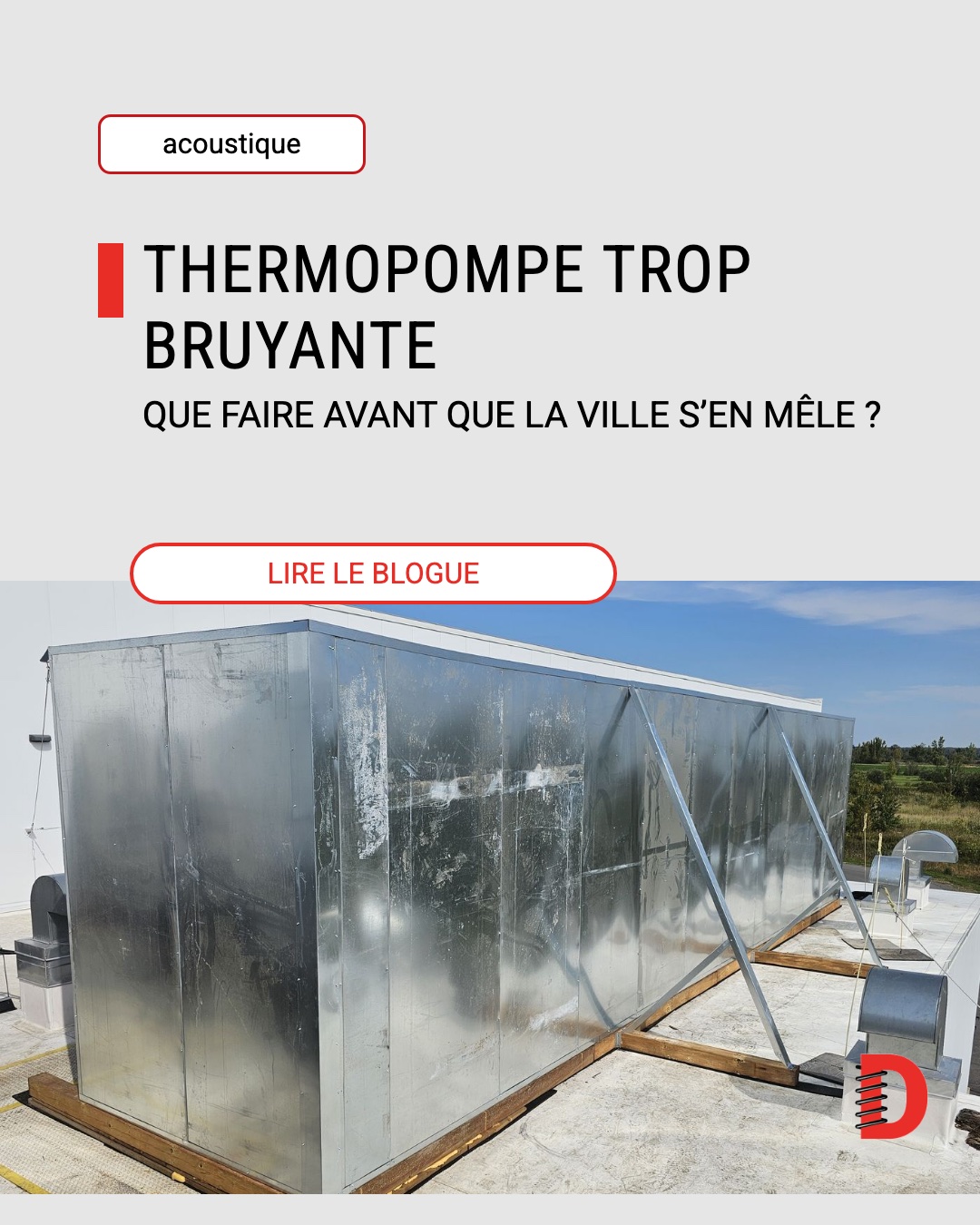
In short: when a heat pump or rooftop unit disturbs the neighbourhood, first find out whether the problem is airborne noise or vibration, then correct the installation, and add a sound barrier or acoustic enclosure if needed. It is better to act before the municipality sends a notice: in Quebec, a Mascouche resident was fined over a heat pump her city judged too loud, according to Noovo Info.
1. Check your municipality's by-law
Each municipality sets its own noise rules: permitted levels, hours, how levels are measured. They vary from one city to the next. Ask for the by-law that applies to your address before choosing a solution, so you know which level you have to reach.
2. Noise or vibration?
Airborne noise comes out of the fan and the compressor and travels through the air to the neighbour. Vibration passes through the unit's supports, enters the structure and is heard elsewhere in the building. The two are not solved the same way, and both are often present at once. Our article on the difference between acoustics and anti-vibration explains how to tell them apart.
3. Correct the installation first
- A unit sitting directly on the structure transmits its vibration to it. Pads, rubber floor mounts or spring isolators cut that path.
- A rooftop unit ideally sits on an anti-vibration rail.
- A unit placed against a wall or in a corner has its noise reflected by the surfaces around it.
4. Block the remaining noise
When the unit is properly installed and the noise still exceeds the limit, the airborne noise is treated:
- a sound barrier stands between the unit and the area to protect, straight, L-shaped or U-shaped;
- an acoustic enclosure covers the unit completely, when a barrier is not enough.
The barrier must both block and absorb sound; our guide to NRC and STC explains why.
5. Measure, then document
An acoustic study measures sound levels, identifies the sources and sizes the solution. In a turnkey project, Deflection can visit the site and provide a compliance report at the start and at the end of the project, which gives you evidence to show the municipality.
Frequently asked questions
Is a sound barrier always enough?
No. If part of the problem is vibration, the barrier will not solve it: the unit also has to be isolated from the structure.
Who handles the installation?
Deflection offers turnkey projects: consultation, acoustic study, manufacturing in Quebec and installation.